
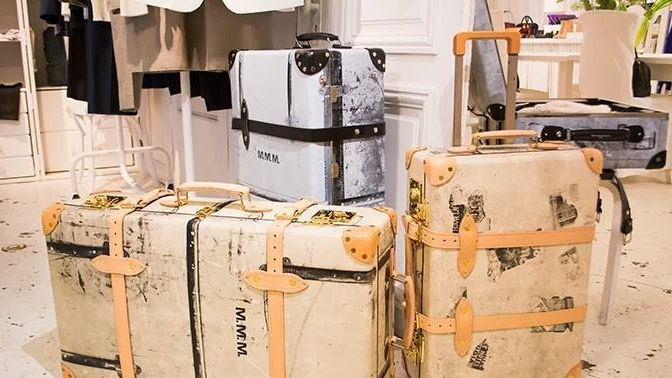
The German luggage house and the Parisian fashion label join forces for a limited-edition collection that celebrates craftsmanship, individuality, and the beauty of objects that evolve with time.
Luxury has traditionally been associated with perfection: immaculate materials, flawless finishes, and carefully preserved objects that maintain their original appearance.
But two influential names in contemporary design are challenging that idea.
Rimowa and Maison Margiela have introduced a limited-edition travel collection that explores an unconventional concept: the possibility that a luxury object becomes more interesting as it ages.
Unveiled on November 12, 2026, the collaboration brings together Rimowa’s recognizable aluminum luggage and Maison Margiela’s experimental approach to fashion and craftsmanship.
The result is a collection that exists somewhere between functional travel accessories and contemporary design objects.
Two Design Philosophies, One Creative Vision
At first glance, Rimowa and Maison Margiela might appear to approach luxury from different perspectives.
Founded in Germany, Rimowa has built its reputation around technical precision, durability, and the unmistakable grooved aluminum suitcases that have become synonymous with luxury travel.
Maison Margiela, meanwhile, has established a distinctive identity through deconstruction, unconventional materials, and an ongoing fascination with the relationship between clothing, identity, and time.
Despite these differences, both brands share an appreciation for craftsmanship and objects that develop character through use.
Their collaboration translates that philosophy into a coordinated travel collection featuring two signature pieces: the Rimowa Classic Cabin suitcase and Maison Margiela’s 5AC XL bag.
Rather than simply placing two logos on existing products, the brands have incorporated elements of each other’s design language.
The Beauty of Imperfection
One of the most distinctive aspects of the collaboration is Maison Margiela’s signature Bianchetto technique.
The process involves applying white paint to a surface, allowing the finish to evolve naturally through use.
As the object travels, subtle marks, scratches, and changes in texture become part of its appearance.
Instead of treating these imperfections as damage, the concept encourages owners to see them as evidence of personal experiences.
A suitcase that has traveled across continents becomes a visual record of the journeys it has accompanied.
A bag that changes over time becomes increasingly individual.
This approach offers a compelling alternative to the traditional luxury obsession with keeping every possession in pristine condition.
A Closer Look at the Collection
The Rimowa x Maison Margiela Classic Cabin maintains the technical elements associated with the luggage house, including its aluminum construction, telescopic handle, Multiwheel system, and TSA-approved locks.
However, its interior introduces an unexpected fashion-inspired treatment.
Visible stitching, overlocked edges, and white lining create the impression of a garment turned inside out.
The detail references Maison Margiela’s longstanding interest in exposing construction techniques that conventional design often conceals.
The 5AC XL bag receives an equally distinctive transformation.
Rimowa’s signature grooves are recreated across the leather surface, creating a textured architectural appearance.
The bag includes a crossbody strap and removable leather attachments that allow it to be secured to the suitcase during travel.
Together, the pieces form a coordinated travel set in which fashion and functionality become part of the same design conversation.
A Campaign That Blurs Fashion and Art
The creative campaign, directed and photographed by Dexter Lander, extends the collection’s artistic concept beyond the accessories themselves.
Set inside a Haussmannian apartment, the campaign imagines an environment transformed by the application of white paint.
Furniture, architectural elements, and the travel pieces become part of an immersive visual installation.
The imagery reinforces the idea that everyday objects can carry artistic significance.
It also reflects a broader movement within luxury marketing, where brands are increasingly exploring creative storytelling rather than presenting products exclusively through conventional advertising.
The New Language of Luxury Travel
The collaboration arrives at a time when luxury accessories are increasingly being evaluated for their originality, craftsmanship, and emotional significance.
Consumers interested in exceptional design are often seeking pieces that communicate more than recognizable branding.
The Rimowa and Maison Margiela partnership responds to that desire by emphasizing the relationship between an object and its owner.
Every journey has the potential to change the appearance of the pieces, making each one progressively more personal.
The collection is scheduled to become available on November 19, 2026, through selected Rimowa and Maison Margiela boutiques and their respective online stores.
In the United States, the Classic Cabin is listed at $4,300, while the 5AC XL bag is priced at $4,900.
When Travel Becomes Personal Expression
What makes the collaboration particularly compelling is its willingness to reinterpret the meaning of luxury.
Instead of promising that an object will remain unchanged, the brands celebrate its transformation.
The suitcase and bag are designed to accompany their owners through experiences that leave visible traces.
In doing so, Rimowa and Maison Margiela introduce a different understanding of exclusivity: one based not only on how a product is manufactured, but on the individual history it eventually develops.
For travelers who see fashion as an extension of their personal identity, the collection suggests that the most valuable accessories may be those that carry memories as well as belongings.


 Latin Glam

 LatinGlam


